Meet the Tasuki Owl — Why Tasukiba's Mascot Is an Owl
Why a mascot at all
After articulating the six axes of differentiation (last post), the next thing I had to decide was the service’s visual symbol — its character.
Features and tagline carry a worldview only so far.
I wanted users to feel the temperature of the service in the first second, before reading anything. That requires a device. I picked a mascot.
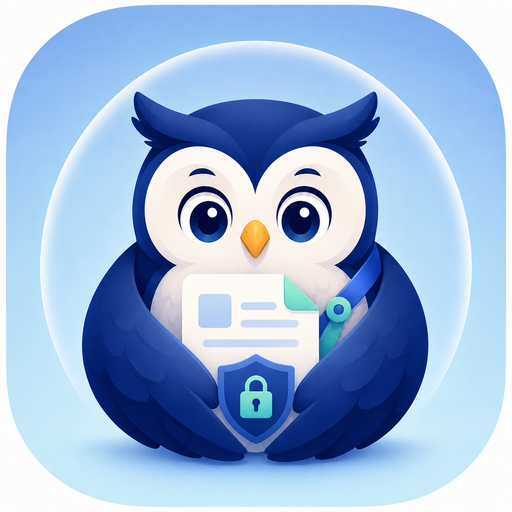
Its name is the Tasuki Owl. Today’s post is about why an owl, and why I treated this decision seriously instead of shrugging it off.
Three symbols
The reason for an owl is that three symbols line up cleanly with the product’s three axes.
1. Wisdom
In Greek myth, the sacred bird beside the goddess Athena is an owl. In Western culture, the owl became the symbol of wisdom and learning.
Tasukiba is a service that activates accumulated past assets — knowledge, risks, issues, retrospectives — so smarter decisions become possible. “A service for handling wisdom” and the owl’s symbol overlap without forcing.
2. Memory
Owls see in the dark. They don’t lose their prey in low light.
Tasukiba’s core value is surfacing past assets buried in the dark. “Still visible when buried” maps to the owl’s vision in a way I couldn’t engineer if I tried.
It’s also a visual inversion of the problem I named in series part 1: “data the decision-maker’s eye never lands on gets treated as if it doesn’t exist.” The owl is the eye that does land on it.
3. Protection
Across cultures, the owl is a household guardian. In Japanese, the word “fukurou” can be written with characters meaning “without hardship” — a charm.
Tasukiba watches over project operations and supports them quietly, so risks and issues don’t surface as crises. “A companion that watches over” lines up with the owl.
Three symbols carried by one animal: that doesn’t happen often. The four-candidate comparison that produced this decision will get its own post later.
The name “Tasuki Owl”
The service name Tasukiba means “the place where the relay baton (tasuki) is handed over.”
Like a relay runner passing the baton, project knowledge gets handed forward — from a past project to a new one. The service is the ba (place) where that handoff happens.
The Tasuki Owl is positioned as the one who watches the baton and, at the right moment, quietly says “didn’t you forget this one?”
Not pushing. Quietly handing it over. That’s the role I’m drawing for them.
The worldview rules for the character
When using the Tasuki Owl in icons, illustrations, and copy, the worldview rules are explicit.
Expression direction
- Restrained palette — same root as the tidy-UI philosophy
- Quiet tone — not pushy
- Watching gaze — from the side or slightly below, not above
- Companion, not expert — “helping you notice,” not “telling you”
What to avoid
- Flashy animation — clashes with the calm tone
- Pointing-finger pose — too gatekeeper-like
- Over-anthropomorphization (SD or kids’ style) — erodes business-user trust
Copy direction
- Passive-leaning rather than imperative — “this is here, if you want it” instead of “look here”
- Suggestion, not assertion — “you might try” instead of “you should”
- Self-reliance, not dependence — “so you can remember” instead of “I’ll help you”
These three phrasings were chosen with care. The mascot’s voice becomes the service’s voice. I’m being stubborn about making sure users never feel pushed.
Why I refuse to treat the mascot as nice-to-have
In indie development, mascots get treated as decoration. I disagree.
The first point of contact with a service isn’t the logo or the tagline — it’s the felt temperature. Temperature is communicated more strongly by the UI and the character on it than by anything else.
Whether a user thinks “this service feels nice” in the first second is, in my experience, as decisive for initial trust as any feature.
The Tasuki Owl is the device that conveys Tasukiba’s temperature without speaking. Same root as the “attitude as message” idea in The Courage to Be Disliked, Part 3 — here and now.
One sentence
Compressed:
A presence that doesn’t push — that quietly watches.
Wisdom, memory, protection — three symbols on the shoulders of one bird, watching the tasuki get passed. The Tasuki Owl will appear throughout the rest of this series.
Next time, the final post of Chapter A: the Discord community as a “graduation culture” — why I want to bring the word “graduation,” not “leaving,” into a business SaaS community.
Related posts
- Six axes that set Tasukiba apart — not from market research, from stubborn preference — series part 4, differentiation
- Why I obsess over a tidy UI — tracing it back to a high-school notebook — same root as the mascot’s restrained expression
- The Courage to Be Disliked, Part 3 — here and now — attitude as a message that precedes words
About Tasukiba
The Tasuki Owl appears on the product page and across the site. You can see how “quiet, watching, not pushy” actually plays out on screen.